What Is Malva AI and How Can You Create a Better AI YouTube Channel in 2026?
Malva AI proved a 100% AI YouTube channel can grow past 100K subscribers. See what works, what does not, and how to build a better one with Argil.
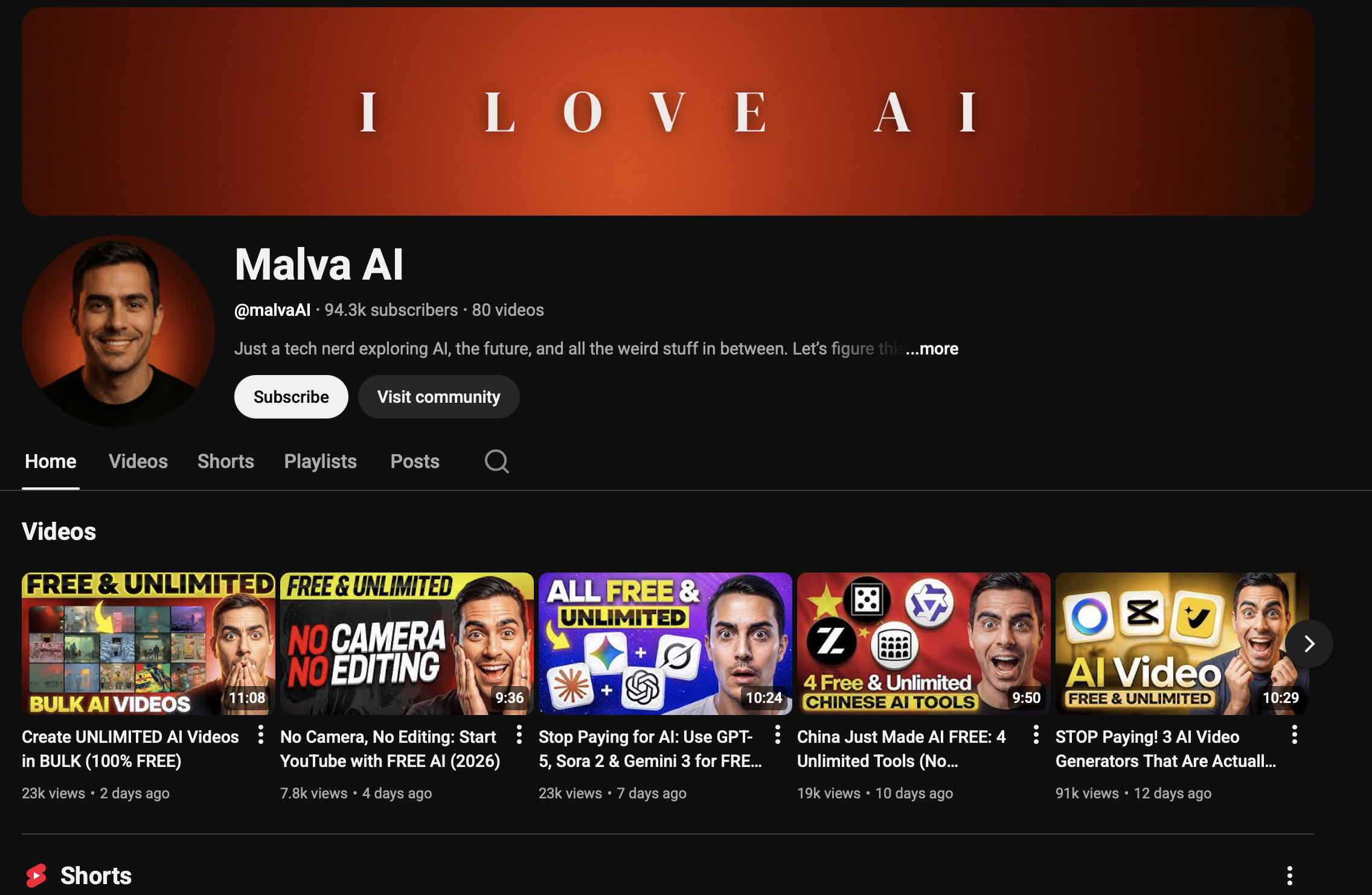
What Is Malva AI?
If you've watched YouTube recently, there's a good chance you've come across Malva AI. The channel showcases videos entirely created using AI tools, no human presenter, no cameras and no manual editing. Malva AI features tutorials on how to use artificial intelligence tools to produce videos, images and short-form content.
In short, Malva AI is a faceless YouTube channel where AI handles the entire production run, from the script down to the final edit, with no human on camera and no manual step anywhere in the process. It grew past 90K subscribers within its first year and has since climbed well past 100K, giving hundreds of thousands of people inspiration and a rough playbook for launching an AI YouTube channel of their own.
The success of Malva AI proves that it's possible to consistently grow a video channel without traditional production workflows. At the same time, it also highlights the limitations of automation when personality, creativity and connection are missing.
This article breaks down what Malva AI actually is, why it gained attention online and how creators in 2026 can build better AI YouTube channels using a more advanced and sophisticated tool.

About Malva AI: the 100% AI YouTube Channel
Malva AI is a faceless YouTube channel that uses artificial intelligence for every stage of production. According to the channel's bio, Malva AI is run by "a tech nerd exploring AI, the future and the weird stuff in between."
While the face in the channel's bio and video thumbnails represents a human, the channel is 100% AI-generated. Topics are generated automatically, scripts are written by language models and scripts are obviously voiced by AI. Visuals rely on stock footage, looping backgrounds and static imagery paired with captions.
There is no human host and no manual creative input once the system is running, which is precisely what makes Malva AI so notable. Not only does it show what's possible in 2026, but also how far automation can be pushed.
The channel publishes content at a volume most solo creators could never maintain manually. Shorts, long-form videos and experiments across niches are all produced in minutes, with no human input whatsoever. For people interested in passive income, faceless branding or scalable content systems, this is a hugely impressive feat, especially if videos can be monetized.
The success of Malva AI also mirrors a wider trend of using animated or artificially generated faces in videos, where creators remove themselves from production to achieve consistency and speed. However, the same characteristics that make Malva AI impressive are also its biggest weaknesses.
Why Malva AI Went Viral in 2025 and What It Reveals About YouTube's Future
Unlike most successful YouTube channels, Malva AI didn't grow because it was entertaining or emotionally resonated with audiences. It grew because it aligned perfectly with how YouTube rewards behaviour in the modern age.
As the world's biggest video platform, YouTube increasingly favours consistent publishing, topical relevance and searchable formats with optimized thumbnails. Malva AI leaned into all of these and managed to crack YouTube's algorithm, gaining hundreds of thousands of followers in the process.

For viewers, the appeal of Malva AI is all about novelty. A fully AI-generated channel feels futuristic and inspirational. Malva AI shows creators that publishing daily or multiple times per day is achievable without a production team, and, crucially, that anyone can do it.
However, as we're already starting to discover, virality driven by volume has limits. Many Malva AI viewers do not become loyal subscribers. Watch time often drops quickly after the initial novelty has worn off, and comments frequently mention the robotic delivery or repetitive structure of the AI-generated videos.
In other words, Malva AI works more like a content churning machine than a brand, team or human creator.
Why You Shouldn't Copy Malva AI's Model Directly
As Malva AI continued to garner attention, dozens of similar channels appeared. Most followed the same formula: dull scripts, generic text to speech voices and stock visuals. All this AI-generated content just added to an already oversaturated environment where channels compete on speed alone.
In 2026, viewers are far more aware of AI-generated content. They don't reject it outright, but they do expect coherence, pacing and intention rather than just mindless repetition. A video that feels stitched together without care is easy to skip when there's so much better content available. Building a personal brand still beats building a content farm, even when both are AI-assisted.
This is why pure automation, like the kind showcased by Malva AI, is no longer enough for modern digital creators. Tools should amplify creativity, not replace it completely. Malva AI demonstrates what happens when automation leads and creativity drops out of the equation completely, and it has a very limited shelf life.
The risk isn't theoretical either. In January and February 2026, YouTube removed 16 mass-produced channels carrying a combined 35 million subscribers, wiping 4.7 billion lifetime views and an estimated 9.8 million dollars a year in ad revenue between them. None were removed for using AI. They were removed for being mass-produced: the same structure, the same synthetic narration, the same visual template, published at a volume no original production could sustain.
In July 2025, YouTube tightened its monetization rules for AI-generated video, requiring ad-supported content to be genuinely original rather than mass-produced or repetitive. YouTube sharpened that policy again in July 2026, splitting it into 3 specific triggers for losing Partner Program eligibility: generic or repetitive content that duplicates what already exists on the platform, content designed to manipulate emotion (think manufactured distress-then-rescue arcs), and AI personas discussing sensitive topics like finance, healthcare or legal advice. A mandatory disclosure requirement for synthetic media, introduced in January 2026, now sits alongside it. Low-effort automated content, or generic stories and compilations trying to pass as human-generated, risks losing monetization entirely.
How to Build a Better Malva AI-Style Channel Using Argil
YouTube encourages responsible use of AI as a creative partner, rather than a replacement for human effort. This is where Argil enters the picture, offering a much more sustainable alternative to Malva AI style content.
Argil allows you to keep the scalability that made Malva AI appealing, while solving its biggest issues: lack of personality, weak scripting and generic delivery.

Instead of relying on anonymous narration like Malva AI, Argil puts you in the director's chair. You cast your characters once and their face, body and voice stay locked in every video after that, and the locations, props and house style sit on the same record. The work runs from an idea to a storyboard you approve shot by shot and then to the finished film, so a later episode still looks like the first one instead of drifting. For a sense of how that holds up next to the other big names creators weigh up, see how Argil compares to HeyGen. If you want a channel that carries a recognizable identity rather than feeling generic, getting that identity right is what makes the difference.
Scripts are also handled differently. Rather than scraping surface-level summaries, Argil generates scripts based on niche, audience intent and content goals. You can guide the tone, structure and pacing of your script and edit it directly in one interface, then turn the finished script into finished videos without filming anything.
With Argil, editing, captions, transitions and B-roll are automated in a way that feels natural rather than overproduced. This makes videos easier to watch and more likely to retain viewers. Most importantly, Argil supports experimentation and human input. Intros can be swapped, hooks can be tested, characters can be recast and entire formats can be adjusted easily.

Malva AI vs Argil: Why AI-Assisted Videos Will Always Win Over Complete Automation
Malva AI shows what happens when automation is pushed to its extreme. Argil answers a different question: how do you scale without having to spend hours filming and editing every day?
With Argil, you don't sacrifice your creative identity for speed. You get the benefits of automation while staying present in your content. For creators, educators and solopreneurs, this balance is what separates channels that spike engagement briefly from those that compound over time, and that keep their monetization intact as YouTube's rules keep tightening.
Ready to Build a YouTube Channel Like Malva AI That People Actually Subscribe To?
Malva AI proved that AI-powered YouTube channels are viable. What it didn't solve was how to build a channel that's memorable, trustworthy and sustainable.
Argil gives you the tools to do exactly that. You can keep automation, speed and scale, while adding voice, presence and intention to keep your viewers genuinely engaged.
If you're curious about building a Malva AI-style channel but want better results, start by experimenting with Argil. Generate scripts, cast your characters and see how different the content feels when it sounds like it comes from someone, not something. Sign up today to get started.